
Unveiling the Truth Behind Mozart’s Thematic Catalogue
Groundbreaking Research Published in the Journal of Forensic Document Examination
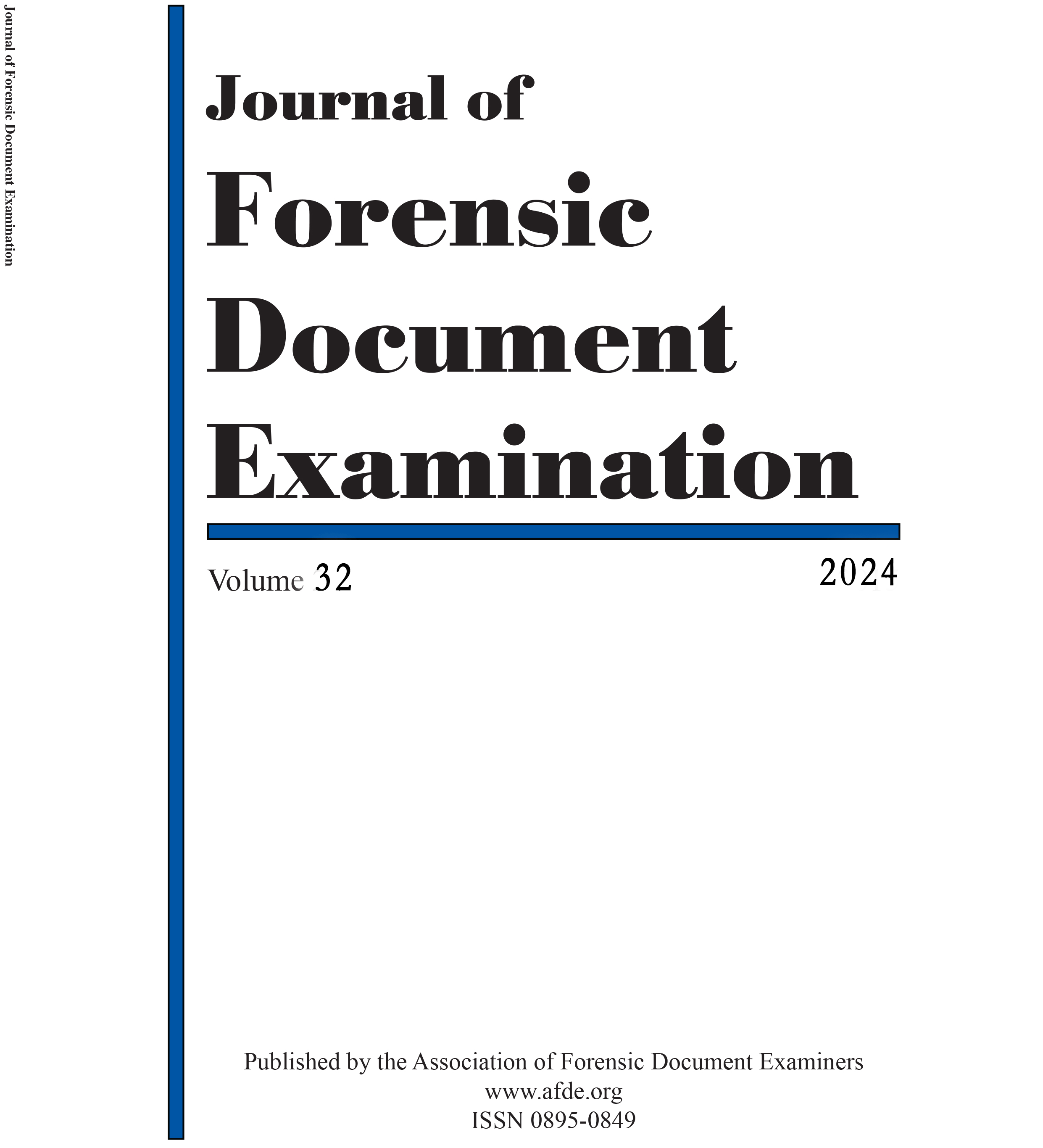
Anna Trombetta, Professor Martin W. B. Jarvis from Charles Darwin University, and I, Luca Bianchini, have published a peer-reviewed article titled Unveiling a New Sophisticated Ink Analysis Technique, and Digital Image Processing: A Forensic Examination of Mozart’s Thematic Catalogue.
This research, which underwent an extensive double-blind peer review, has appeared in a journal that serves as a global reference point for forensic document examiners and court specialists.
"Our findings reveal that the Thematic Catalogue, a supposed cornerstone of Mozart scholarship, is in fact a meticulously constructed posthumous forgery."
The Authors
What Did We Discover?
Our investigation reveals that Mozart’s Thematic Catalogue, long considered a primary source for dating his compositions from 1784 to 1791, is in fact a posthumous forgery created around 1798 at the behest of Constanze Mozart. This finding calls into question the attribution, dating, and cataloguing of many works credited to Mozart.
The Innovative Ink Analysis Technique
I developed a state-of-the-art software in C# that performs a non-destructive analysis of the inks used in historical manuscripts. By breaking down high-resolution images into their red, green, and blue (RGB) components, our method distinguishes between different ink compositions and exposes chronological inconsistencies. This approach not only revealed multiple stages of writing in the Thematic Catalogue but also offers potential applications for authenticating other 18th-century documents, such as manuscripts by Beethoven or other composers.
Why Does This Matter?
The implications are far-reaching. The Thematic Catalogue has underpinned the official narratives and cataloguing systems of Mozart’s works. Our findings necessitate a major re-evaluation of these attributions, affecting the entire field of Mozart scholarship.
Contact Us for More Information
We welcome discussions with journalists, musicologists, and forensic experts. If you have questions or wish to interview the research team, please don’t hesitate to get in touch.
Stay Updated
Follow our research and related events on Mozartrazom and our affiliated websites. We are committed to disseminating our findings broadly and engaging with a diverse international audience.
Thank you for your interest in our work. We invite you to explore, question, and rethink what you know about one of the most celebrated composers in history.
Keywords
- Mozart, Thematic Catalogue, forensic analysis, ink composition, manuscript authenticity, Constanze Mozart, Martin W. B. Jarvis, digital image processing, musicology, historical forgery, primary source verification.
You May Also Like
The Fabricated Childhood of Mozart
The legend of young Mozart’s divine genius crumbles under scrutiny, revealing a childhood dictated by Leopold’s ambition, carefully constructed myths, and a relentless pursuit of fame at the expense of genuine artistic education.

The Man Behind the Myth
Leopold Mozart’s legacy has been shaped by myths and hagiographies, but his letters reveal a man more concerned with financial gain and self-promotion than artistic integrity. Was he truly a devoted father, or simply an opportunist?

Constanze vs. The Catholic Church
For over two centuries, scholars have debated the circumstances surrounding Mozart’s burial. Constanze Mozart’s supposed inability to mark his grave, the confrontation with the Catholic Church over funeral masses, and the baffling disappearance of Mozart’s body all contribute to a mystery stranger than fiction. Did a powerful group keep her silent? And what really happened to Mozart’s remains?

Constanze Mozart’s Enduring Love
Although some have doubted her devotion, Constanze’s own words and actions illustrate a widow deeply committed to preserving Mozart’s legacy. Diaries, personal correspondence, and eyewitness testimony all challenge the notion that she neglected his memory—while the circumstances around his burial grow ever more perplexing.
A Revealing New Interview on His Thematic Catalogue
We’re excited to present a brand-new interview that challenges many of the long-held assumptions about Mozart’s Thematic Catalogue (1784–1791). Conducted by Swedish journalist Henry Grynnsten, this conversation delves into groundbreaking forensic techniques—like advanced ink analysis and digital image processing—that may change the way we view Mozart’s late works.
The Rattling Symphony: A Critical Take on K. 17
Often attributed to Mozart, the K. 17 symphony is anything but refined. Lacking orchestration and filled with gaps, it raises more questions than answers about its true authorship.
It is not surprising to me, as a Mozart researcher, that Constanze Mozart discovered that the public could be defrauded, easily. She carried this out directly after Mozart’s death by discovering an unfinished score – a Requiem — in a mass of Mozart’s scores in a closet. Realizing that she could sell a completed score to music publishers and wealthy Mozart afficionados in Vienna and abroad, she presented this as Mozart’s ‘swan song’. She found her solution in Franz Sussmayr, Mozart’s copyist, who secretly finished a score. He confessed this in a letter of 8 February 1800 to music publisher Christoph Breitkopf. So it’s no surprise that in 1798 or 1799, she perpetrated another fraud — creating a Mozart catalogue, with false entries of her husband’s compositions, hoping to make money from it. Bianchini and Trombetta’s meticulous research exposes Constanze’s deception, excellently.