
Beyond the Notes
The Human Side of Genius
By H. S. Brockmeyer
We are thrilled to present an exclusive and deeply insightful long-form essay by our esteemed friend and distinguished Mozart scholar, H. S. Brockmeyer. In this meticulous piece of research, H. S. Brockmeyer peels back the layers of Romantic idealism that have long surrounded Wolfgang Amadeus Mozart to reveal the man beneath the wig.
With a scholar’s eye for detail and a storyteller’s touch, H.S. Brockmeyer delves into the famous “Bäsle letters”—correspondence between Mozart and his cousin that has baffled and amused historians for centuries. Rather than shying away from the composer’s earthy, scatological humor, this article contextualizes it within the culture of the 18th century and the psychology of a boundless creative spirit. It is a brave, humorous, and historically rich examination that challenges our perception of the “divine” Mozart, bringing him closer to us in all his human complexity.
Please enjoy this extraordinary contribution by H.S. Brockmeyer.
Luca Bianchini & Anna Trombetta
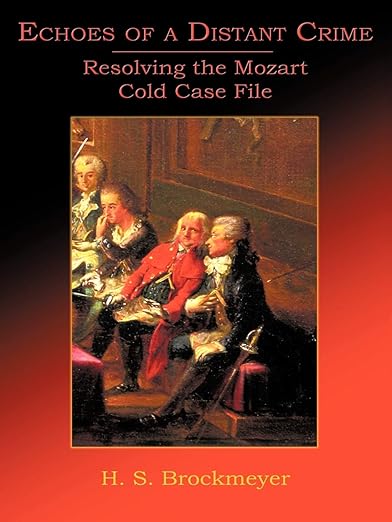
"As an historical author, I take umbrage at Mozart aficionados, who try to portray him in a purely romantic light, who whiled his days composing fairy music, ethereal tunes... Alas, this image is far from reality. Mozart was, actually, a bawdy music man."
H.S. Brockmeyer
Abstract
For centuries, biographers have polished the image of Wolfgang Amadeus Mozart, presenting him solely as a divine, Apollonian genius untouched by the vulgarities of common life. However, a collection of private correspondence known as the “Bäsle letters” reveals a drastically different, and often shocking, side of the composer. Addressed to his cousin and close companion, Maria Anna Thekla, these letters are infamous for their uninhibited scatological humor, linguistic acrobatics, and chaotic energy. In this insightful essay, musicologist H. Brockmeyer challenges the prudish censorship of the 19th century to explore the raw, human reality of Mozart’s personality. By examining the cultural context of 18th-century “Hanswurst” humor, the Mozart family’s own eccentric dynamics, and the psychological theories surrounding his behavior, this piece offers a fresh perspective on the man behind the masterpiece. It is an invitation to look beyond the powdered wig and discover a Mozart who was as earthly and irreverent as he was musically sublime.
MUCK, CHUCK! –MUCK! –SUCK—O CHARMANTE!
Mozart, the coprophilia, and the Bäsle Letters
A Critical Introduction to the Work of H. S. Brockmeyer
For nearly two centuries, the cultural consciousness has worked tirelessly to polish the image of Wolfgang Amadeus Mozart into a figurine of porcelain perfection. We are fed the myth of the “eternal child,” the divinely inspired vessel through which God’s own music flowed—pure, untouched, and ethereal. Yet, any true historian knows that the brighter the light, the longer the shadow. In her fascinating and meticulously researched essay, H. S. Brockmeyer dares to step into those shadows, offering us a portrait of the composer that is startlingly, brilliantly human.
In this piece, Brockmeyer tackles one of the most controversial and frequently censored aspects of the Mozart archive: the infamous “Bäsle letters.” These are the missives sent by a young, exuberant Wolfgang to his cousin, Maria Anna Thekla, during a period of his life defined by transition and emotional volatility. Where traditional biographers have often turned a blind eye, blushing at the content, Brockmeyer leans in with a magnifying glass.
What she reveals is not the “divine child,” but a man of flesh and blood—a man possessed of a “boundless and unbounded” sense of humor that leaned heavily into the scatological. Brockmeyer navigates the reader through the “muck” and “chuck” of Mozart’s correspondence, not for the sake of shock value, but to contextualize the genius within his time. She masterfully explains the influence of the coarse German “Hanswurst” theater tradition and the peculiar, earthy dynamics of the Mozart family itself, dismantling modern diagnoses of madness in favor of a more nuanced cultural understanding.
Brockmeyer’s writing is as engaging as it is scholarly. She writes with a palpable affection for her subject, yet she refuses to romanticize the “potty-mouthed” adolescent who penned these letters. Instead, she draws a poignant contrast between the sublime, soaring arias of The Marriage of Figaro and the chaotic, visceral reality of the man who wrote them. We are shown a Mozart who used vulgarity as an escape valve for the immense pressure of his genius—a “bawdy music man” who found solace in the ridiculous.
This essay is more than a historical curiosity; it is a necessary corrective to the sanitized history we have been sold. It is a story of unrequited affection, of family politics, and of a genius who was, perhaps, too alive for his own good. Brockmeyer invites us to laugh with Mozart, to be shocked by him, and ultimately, to understand him better.
It is a brave, humorous, and deeply deeply insightful piece of writing. We invite you to read the full text and discover the Mozart you never knew existed.
You May Also Like
The Other Side of Mozart’s Legacy
Explore the untold story of Mozart, where myth and reality collide. Our critical examination of his life and works reveals a legacy shaped by profit, myth-making, and misattribution. Join us in uncovering the truth behind the man and his music.
The Deception Surrounding Mozart’s Legacy
Anton Eberl’s confrontation with Constanze in 1798 exposed a web of deceit surrounding Mozart’s legacy, revealing that several of his compositions were falsely attributed to the late composer. This chapter uncovers the ethical dilemmas and controversies that have marred the posthumous reputation of one of history’s most celebrated musicians.
Leopold’s Invisible Hand
Behind the glittering performances of young Wolfgang and Nannerl Mozart lay the meticulous guidance of their father, Leopold. Often considered a mere teacher, Leopold’s role in composing and shaping their early musical successes has been largely overlooked. Was the child prodigy truly a genius, or was it Leopold who orchestrated his son’s rise to fame?
Debunking the Romantic Virtuoso Image
The image of Mozart as a Romantic-era virtuoso is a misleading anachronism, fuelled by 19th-century propaganda. Wolfgang was no transcendental pianist, but a product of an era where music was more galant than heroic.
The Visit to Verona
In Verona, young Wolfgang Mozart impressed the local nobility, but the reality behind the scenes reveals a carefully managed public image, where strategic networking and curated praise played key roles in shaping his growing reputation.
Mozart’s Training
The myth of Mozart’s genius is nothing more than a carefully crafted illusion, propped up by misplaced attributions and romanticised biographies. Behind his so-called brilliance lies the reality of his father’s dominating influence and a lack of formal education.